Loan Rates: Don’t Miss the Crucial September 30 Cutoff
Discover how meeting the September 30 deadline can help reduce interest rates on qualifying federal student loans simply by opting for automatic payments.
Is Your Loan Rate Too High? Steps to Take Before September 30
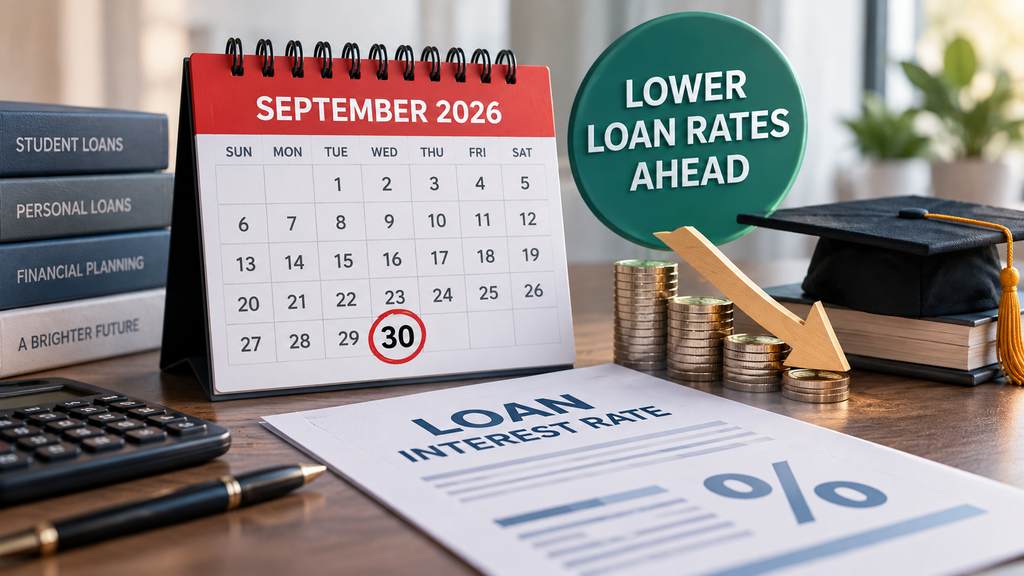
September 30, 2026, marks a crucial deadline for federal student loan borrowers who qualify.
By signing up for automatic payments before 11:59 p.m. on that day, you could secure a temporary 1% cut in your loan interest rate, lasting through June 30, 2028, per the U.S. Department of Education.
This deadline does not cover all loan types. It specifically applies to eligible federal student loans and the Auto Pay interest-rate discount.
If you want to reduce your borrowing costs, here’s what the September 30 deadline involves, who is eligible, how the interest reduction works, and what you should verify before the cutoff.
What Exactly Is the September 30 Loan Interest Rate Deadline?
The September 30 cutoff marks the last day for qualifying federal student loan borrowers to sign up for Auto Pay and take advantage of a temporary 1% interest rate discount.
Starting July 1, 2026, the U.S. Department of Education raised the Auto Pay interest-rate discount from 0.25% to a full 1 percentage point.
Borrowers who enroll by September 30 are eligible to keep this temporary rate reduction until June 30, 2028.
Why Is the September 30 Deadline So Important?
Reducing your loan interest rate can lower the total interest that builds up on your student loan balance.
How much this matters depends on your loan amount, repayment plan, and how much time remains on your loan.
For instance, someone with a $30,000 loan balance would pay about $300 less in annual interest if their rate dropped from 7% to 6%, before considering any principal payments.
This example serves only as an estimate and doesn’t guarantee actual savings for any individual borrower.
Does the September 30 Deadline Apply to Every Loan?
No. This is one of the key distinctions you need to know.
The September 30 deadline does not require refinancing of personal loans, mortgages, auto loans, or private student loans by that date.
This temporary 1% interest rate reduction applies only to eligible federal student loans enrolled in Auto Pay.
Who Is Eligible for the 1% Interest Rate Reduction?
Federal student loan borrowers who sign up for Auto Pay by September 30, 2026, qualify for this temporary 1 percentage-point interest rate cut.
The Department of Education states that the enhanced interest rate reduction applies to eligible Direct Loans that were disbursed on or after July 1, 2012.
You should verify your specific eligibility by checking with your loan servicer.
What If You Already Have Auto Pay?
If you’re currently enrolled in Auto Pay, you typically don’t need to sign up again.
Under the updated system, the total Auto Pay discount rises to 1 percentage point, so those who had a 0.25% reduction can now benefit from an extra 0.75 percentage-point decrease.
Log in to your loan servicer’s portal to verify how the discount is reflected on your loans.
Why Borrowers Should Care About Loan Interest Rates in 2026
Borrowing expenses continue to be a key concern for households across the U.S.
On September 16, 2026, the Federal Reserve increased the federal funds target range by 0.25 percentage points to 3.75%–4%.
In a separate update, the Federal Reserve Bank of New York announced that U.S. household debt totaled $18.8 trillion in the second quarter of 2026.
These numbers don’t directly set the rate an individual borrower receives. Loan pricing varies depending on the type of loan.
However, they explain why many people remain focused on the costs of borrowing.
How Does the Federal Funds Rate Affect My Loan?
The federal funds rate isn’t the same as the interest rate on your student or personal loan.
Instead, it’s the rate banks charge each other for lending reserve balances overnight.
Monetary policy shifts can impact overall financial markets, but their influence on a specific loan varies depending on the credit type and the way its interest rate is set.
Understanding this difference is key when you see headlines about loan rates “dropping” or “increasing.”
Loan Interest Rate vs. APR: What Sets Them Apart?
The interest rate is the percentage charged on the amount you borrow, whereas the APR represents a wider annual cost of the loan, including some fees beyond just interest.
When comparing personal loans, APR is especially helpful since two loans with identical interest rates might still vary due to differing fees.
Why This Is Important When Comparing Personal Loan Offers
According to NerdWallet, personal loan APRs can vary widely—from about 6% up to 36%—depending on the lender and the borrower’s profile.
Their September 2026 figures also revealed notable differences in average prequalified APRs based on credit history.
This means the interest rate someone else gets isn’t necessarily the one you’ll be offered.
How to Verify Your Loan Interest Rate Before the September 30 Deadline
The quickest way to see if this deadline affects you is by reviewing your federal student loan account and checking your Auto Pay enrollment.
Take the following steps:
Step 1: Verify Your Current Loan Interest Rate
Sign in to your federal student loan servicer’s online portal.
Note down the interest rate listed for each loan you have.
Step 2: Confirm Your Auto Pay Enrollment
Navigate to the payment settings area and check if Auto Pay is enabled on your account.
If you’re not signed up yet, follow the enrollment steps outlined by your loan servicer.
Step 3: Confirm Your Loan’s Rate Reduction
Check for details indicating if the Auto Pay discount is applied to your loan interest rate.
If you don’t see the details listed, reach out to your loan servicer directly.
Step 4: Verify Your Linked Bank Account
Ensure the bank account used for Auto Pay is active and has enough funds to cover your scheduled payments.
Step 5: Keep Your Enrollment Confirmation
Once you enroll, save a copy of your confirmation email or any proof of your enrollment.
Keeping this confirmation can help if you need to address any issues with your account later.
Is the September 30 Deadline Relevant for Personal Loans?
No, personal loan borrowers aren’t automatically eligible for a 1 percentage-point rate cut by the September 30 deadline.
If your personal loan has a high interest rate, there might be alternative ways to lower your borrowing expenses.
Some options to consider include:
- Evaluating different refinancing offers
- Consulting your current lender about lower rates
- Boosting your credit score before applying
- Comparing loans by their APR rates
- Shortening the loan term if it’s manageable
Still, when considering refinancing, focus on the overall cost of the loan rather than just the stated interest rate.
What Are the Consequences of Missing the September 30 Deadline?
Failing to meet this deadline doesn’t mean you lose all chances to lower your borrowing costs.
But you might forfeit the chance to benefit from the special, temporary Auto Pay discount available only through the September 30 enrollment period.
What happens if you miss the deadline:
- Review your federal student loan account.
- Reach out to your loan servicer about possible benefits.
- Consider your repayment plans.
- Evaluate other debts with high interest rates.
- If you hold personal loans, explore refinancing options separately.
It’s important to separate this specific federal student loan benefit from general chances to refinance or renegotiate other types of debt.
September 2026 Financial Checklist for Borrowers
September is an ideal time to assess your borrowing expenses.
The Bureau of Labor Statistics has planned several key economic reports this month, including the August jobs report on September 4, the Consumer Price Index for August on September 11, and the JOLTS report on September 29.
While these reports don’t directly set your personal loan interest rate, they help explain the overall economic environment.
Assess Your Debts
Make a straightforward list that includes:
- Loan balance
- Loan interest rate
- APR
- Monthly payment
- Remaining term
- Potential fees
Pinpoint Where Your Costs Are Highest
Start by focusing on debts that carry the steepest interest rates.
Credit cards and certain personal loans often have much higher rates than other types of consumer borrowing.
Look Into Available Loan Discounts
Check if your lender or loan servicer provides perks such as:
- Enrollment in Auto Pay;
- Existing customer connections;
- Participation in particular repayment plans;
- Other qualifying criteria.
Be sure to confirm all terms directly with your loan provider.
Author’s Perspective
The September 30 deadline is important to understand because it marks a clear, official chance for eligible federal student loan holders—not a universal deadline applying to all loans nationwide.
Borrowers who qualify should check their Auto Pay status before the cutoff to confirm they’re receiving the offered interest rate discount.
For everyone else, the takeaway is wider: avoid basing your borrowing choices solely on loan rate headlines.
When evaluating debt options, consider the loan’s interest rate, APR, fees, monthly payments, term, and overall cost together.
This approach helps you better understand the true cost of the loan and decide if switching fits your financial needs.

Recommended Content
Why your card’s annual fee keeps climbing
Learn what drives increases and how to calculate whether your card is still worth it.
Continue reading * You will remain on the current website