
When is the best moment to invest? Understanding why delaying can be expensive
Wondering if there's an ideal moment to start investing? Discover why holding out for the perfect timing might actually be expensive, and how committing to a long-term strategy can pay off.
Why waiting for the perfect moment to invest can be a costly error
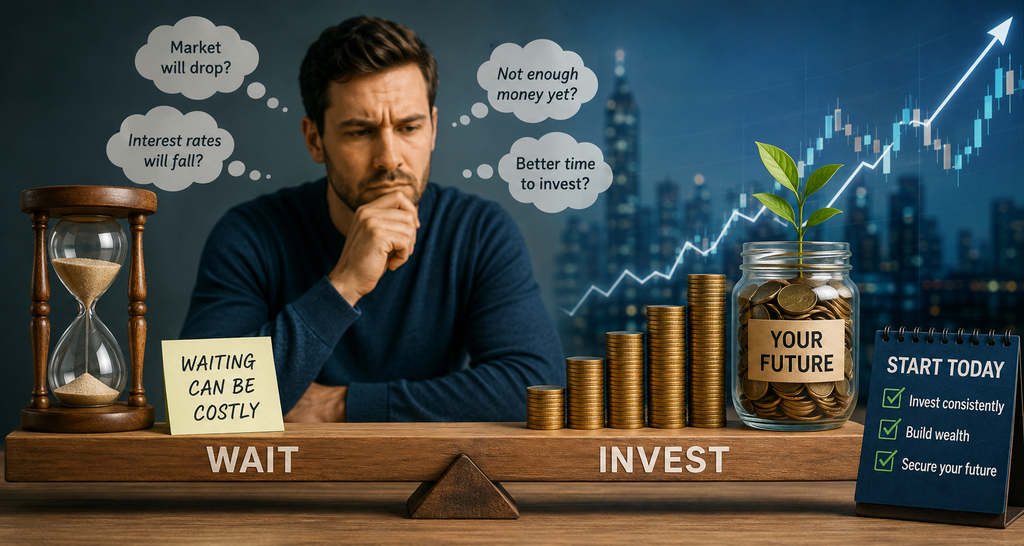
If you keep telling yourself that you’ll only begin investing after the market dips, interest rates drop, or other ideal conditions appear, you might be overcomplicating your start.
The reality is there’s almost never a flawless time to invest. Markets tend to shift before most investors feel ready.
For anyone aiming to grow a retirement fund, build long-term wealth, or just get going with investing, a better question might be, “Is today the right day to start investing?”
Is There Truly a Perfect Time to Invest?
In short, there’s no consistently reliable “ideal” moment to start investing.
Pinpointing the market’s absolute low requires predicting when prices will stop dropping and when the rebound will begin.
This is exactly why market timing is tricky: you have to correctly decide both when to sell and when to buy back in.
However, this doesn’t mean you should invest money you’ll need in the near future without careful thought.
Rather, long-term investors must learn to separate making a well-planned investment decision from waiting endlessly for flawless market timing.
Why Putting Off Investing Seems Like the Safer Option
Choosing to wait can appear to be a prudent financial decision.
You may be thinking:
- “The market is overpriced right now.”
- “I’ll invest after the next downturn.”
- “The Fed could adjust rates soon.”
- “Inflation remains too high.”
- “I need to build more savings first.”
- “I want to learn more about investing before starting.”
These worries are perfectly reasonable.
The issue is that there’s always another excuse to delay investing.
Markets might climb even when economic reports look gloomy. Conversely, they can drop when the economy seems strong.
Interest rates fluctuate. Inflation can catch investors off guard. Unexpected geopolitical events can quickly shift market outlooks.
No single economic indicator can precisely predict when the market will hit its next peak or trough for an individual investor.
Why Staying Invested Often Beats Trying to Time the Market
For long-term investors, a key distinction lies between spending time invested and trying to time the market’s moves.
Market timing focuses on the question: “When is the best moment to buy?”
A long-term approach asks: “How long can I remain invested given my objectives and risk comfort?”
These two questions are fundamentally different.
According to FINRA, a significant portion of market gains and losses happens within relatively brief time frames.
Why Trying to Time the Market Bottom Often Fails
Everyone hopes to buy at the lowest price.
However, the market’s lowest point can only be identified after it has passed.
Picture the market dropping by 15%.
An investor hoping for a “better entry” might hold out, waiting for a further 10% drop.
If the market recovers instead, that investor faces a new choice: invest now at a higher price or continue waiting for another dip.
Understanding Dollar-Cost Averaging and Its Benefits
For those uneasy about investing at an inopportune moment, dollar-cost averaging (DCA) offers a disciplined method to invest gradually instead of holding off.
According to Investor.gov, dollar-cost averaging means putting in equal sums at consistent intervals, no matter how the market behaves.
When prices drop, that fixed amount buys more shares; when prices rise, it purchases fewer shares.
The key point isn’t the exact dollar amount.
When It Actually Makes Sense to Hold Off on Investing
“Don’t wait” doesn’t mean you should invest every dollar right away.
There are valid reasons why investing immediately might not be your best option.
You Lack an Emergency Fund
If investing means you won’t have enough saved to handle unexpected costs like a car repair, medical bills, job loss, or other major expenses, it’s best to wait.
The length of your investment time frame is crucial.
Funds you’ll need in the near future should generally be handled differently than money set aside for retirement years down the line.
According to Investor.gov, both your investment horizon and risk tolerance play key roles in choosing the right investment strategy.
You Carry High-Interest Debt
If you have high-interest credit card debt, investing while your balance keeps growing with interest can complicate your financial goals.
The choice isn’t just about “stocks versus cash.”
It could involve:
paying down debt + building emergency savings + contributing to retirement + investing, based on your situation.
You’ll Need the Funds Soon
A portfolio aimed at a retirement that’s three decades away looks very different from funds you’ll need in the near future.
When you can’t afford to wait for the market to bounce back, short-term ups and downs can pose a significant risk.
The more extended your investment timeframe, the greater your ability to withstand market swings—but that doesn’t mean the risk disappears entirely.
Why August Is a Great Moment to Reassess Your Investment Strategy
For investors, this makes August a useful checkpoint to see if you’re sticking to the strategy you originally set out to follow.
Review Your 401(k) Contributions Before the Year Ends
For most 401(k), 403(b), and government 457 plans, the IRS has raised the employee contribution limit to $24,500 for 2026.
Workers aged 50 and above have a catch-up contribution limit of $8,000, while those between 60 and 63 qualify for an even higher catch-up limit of $11,250.
August is a convenient moment to review how much you’ve contributed so far this year.
You don’t have to make any major adjustments right now.
Evaluate Your IRA Contribution Limits
For 2026, the total contribution allowed for both traditional and Roth IRAs is $7,500, or $8,600 if you’re 50 or older, following the IRS guidelines.
If you haven’t begun contributing yet, the key question isn’t really about whether August is the ideal time to start.
A better question to ask is if delaying your contribution until a later month will genuinely benefit your long-term investment goals.
Avoid Letting Headlines Drive Your Investment Decisions
August 2026 has already brought several reasons for investors to feel uneasy.
In July, the Federal Reserve maintained its target range between 3.50% and 3.75%, noting that inflation remains higher than its 2% goal.
At the same time, July’s CPI reported an annual inflation rate of 3.4%, with energy prices rising 14.7% year-over-year and gasoline costs increasing 24.6%.
These figures are significant.
However, they don’t indicate that you should abandon your personal retirement strategy.
It’s more effective to distinguish economic news from your investing time frame.
How Current U.S. Economic Indicators Affect Investors
These conditions help clarify why deciding “Is now the right time to invest?” can be so challenging.
- Inflation remains above the Fed’s target
- Interest rates continue to play a key role
- The labor market stays relatively steady
What Major Personal Finance Outlets Often Overlook
Leading U.S. financial outlets already offer thorough coverage on market timing, dollar-cost averaging, and strategies for long-term investing.
NerdWallet highlights how challenging and risky market timing can be, while stressing the importance of asset allocation.
Bankrate also focuses on the value of consistency and regular portfolio rebalancing instead of trying to time the market.
Its investment articles often link market trends with Federal Reserve actions and broader economic factors.
Recently, Investopedia explored the balance between dollar-cost averaging and market timing, including historical data comparing these strategies.
Rather than just repeating the phrase “time in the market beats timing the market,” there’s a chance to explore this idea more deeply.
A more effective approach is to address the real concern many have: “What if I invest now and the market drops right after?”
The response should recognize this risk honestly, rather than ignoring the possibility altogether.
It’s true that markets may decline after you make an investment.
However, for investors with a long-term perspective, a short-term dip doesn’t necessarily mean the initial choice was incorrect.
The key is whether the investment aligns with the individual’s time frame, risk tolerance, diversification strategy, and financial objectives.
An Easy Guide to Help You Decide When to Invest
Rather than guessing the market’s next move, focus on answering five key questions.
1. Do I Have Funds That Can Stay Invested?
If you’ll need the money soon, putting it into volatile investments might not be appropriate.
If the funds are meant for a long-term objective like retirement, you generally have more time to withstand market ups and downs.
2. Do I Have an Emergency Fund Ready?
Your investments shouldn’t leave you vulnerable to unexpected expenses that might arise.
Make sure you have a cash cushion suitable for your situation before risking money you could need on short notice.
3. Am I Managing High-Interest Debt?
High-interest debt can seriously hinder your financial progress.
Before concentrating heavily on investment gains, consider the interest rate on any debt you currently owe.
4. Is My Portfolio Diversified?
Allocating all your investments into a single stock, sector, or speculative asset carries a very different risk than maintaining a diversified portfolio.
Investor.gov highlights diversification and asset allocation as key strategies to help manage investment risk effectively.
5. Am I Able to Stick to the Plan During Market Downturns?
This might be even more crucial than figuring out the ideal time to enter the market.
If a drop of 15% to 20% would trigger panic and prompt you to sell, your portfolio may not fit your comfort with risk.
The goal isn’t to create a portfolio that never experiences losses.
The goal is to design a financial strategy you can realistically maintain over time.
The Author’s Perspective
One of the most common errors is believing that successful investing depends on accurately forecasting the future.
But it doesn’t.
You don’t have to predict whether stock prices will rise next month.
Nor do you need to forecast the Federal Reserve’s upcoming moves or the exact timing of inflation settling back to 2%.
You need a plan that addresses three fundamental questions:
This doesn’t mean jumping into investments you don’t fully grasp.
It’s about understanding the line between being careful and being stuck by doubt.
The best investing habit might not be picking the perfect moment.
Instead, it could be making a wise choice, setting it on autopilot when fitting, spreading your investments, and allowing time for growth.
According to Investor.gov, consistent investing over time plays a crucial role in building wealth for the long haul.

Recommended Content
Savings rates are dropping
Learn how lower APYs, inflation and your savings strategy can affect your money and purchasing power.
Continue reading * You will remain on the current website