
What’s the ideal number of credit cards for frequent travelers?
The Optimal Credit Card Setup for Travelers

Among frequent U.S. travelers, there’s a widely accepted but misleading belief that’s hard to shake.
It appears in “wallet setup” videos, points-and-miles communities, and influencers showcasing piles of metal credit cards as symbols of financial status.
The message they send is consistent:
Owning more credit cards makes you look financially savvy.
We don’t buy it. To be clear:
The majority of American travelers hold too many cards, end up paying needless fees, and mistake complexity for true financial skill.
If you have to consult a spreadsheet every time you pay for a meal in Chicago, reserve a hotel in Miami, or book a flight to London, your system isn’t working.
This isn’t strategy—it’s just clutter disguised as smart planning.
Is keeping it minimal really worth it?
The disciplined spender—the traveler who truly grasps financial freedom—crafts a wallet that’s streamlined, reliable, and refined.
Being minimalist doesn’t require sacrificing perks. It’s about cutting out unnecessary overlap.
Experian’s official statistics reveal that the typical American holds about four active credit cards.
What’s the issue?
Many of these cards are kept without any deliberate or strategic reason.
And for frequent travelers, that number tends to be even higher.
The title shouldn’t be: “How many cards can I juggle?”
The real title is:
How many cards provide the greatest benefits with the least hassle?
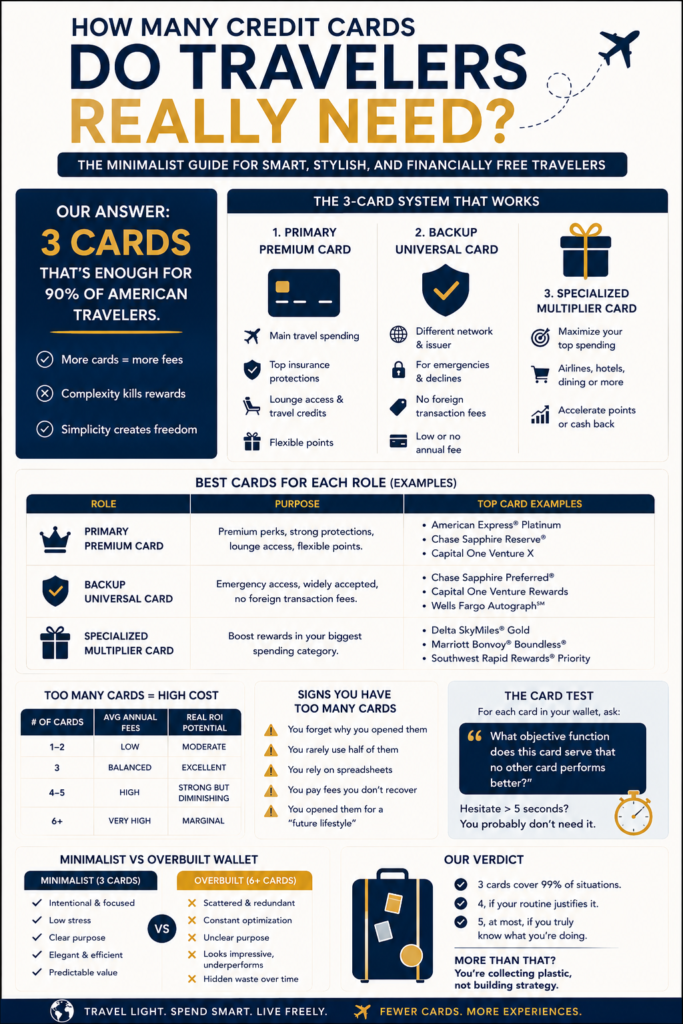
Our straightforward conclusion: For 90% of American travelers, three cards suffice.
Here’s the reasoning.
The Hidden Cost of Too Many Cards
| Number of Cards | Average Annual Fee Burden | Management Complexity | Real ROI Potential |
|---|---|---|---|
| 1–2 | Low | Minimal | Moderate |
| 3 | Balanced | Low | Excellent |
| 4–5 | High | Medium | Strong but diminishing |
| 6+ | Very High | High | Marginal gains |
The 3-card system that actually works
The most successful travelers we study tend to keep things straightforward with this setup:
The Smart Setup
- 1 primary premium card
- 1 universal backup card
- 1 specialized spending card
This arrangement handles nearly everything without clutter, overlap, or unnecessary fees.
Card 1: The core driver of your travel toolkit
This card fuels your ability to move around the world.
It should provide:
- no foreign transaction fees
- comprehensive travel insurance
- coverage for rental cars
- protection against trip delays and cancellations
- airport lounge access or valuable travel credits
- a rewards program with flexible redemption options
Currently, three cards lead the U.S. premium travel market.
American Express Platinum Card
Perfect for airport luxury seekers. Best suited for travelers who appreciate:
- Access to Centurion Lounges
- Automatic elite status at hotels
- Generous travel statement credits
The catch? Many pay the hefty annual fee without taking advantage of most perks.
If you’re not a frequent traveler, this card can cost more than it’s worth.
Explore with us the credit card benefits that genuinely make a difference.
JPMorgan Chase Sapphire Reserve
Arguably the most well-rounded travel credit card on the market.
- Versatile points.
- Strong insurance coverage.
- Easy-to-understand redemption.
- No complex juggling within the Amex system.
In our view, it outperforms Platinum for most savvy travelers in everyday use.
Capital One Venture X
Likely the top premium value card available in the U.S. right now.
It offers high-end perks combined with impressively straightforward management.
If you seek simplicity and real value without flashy gimmicks, this card deserves your consideration.
Card 2: The backup that rescues your trips
This card rarely features in lifestyle videos.
Yet it can prevent major headaches.
Imagine this:
During a layover in Tokyo, a traveler finds their Amex card blocked because of unusual transaction activity.
A backup card comes through just in time.
Your perfect backup should have:
| Criteria | Required? |
|---|---|
| Different network | Yes |
| Different bank issuer | Yes |
| No foreign transaction fees | Yes |
| High annual fee | No |
Reliable choices:
- Chase Sapphire Preferred
- Capital One Venture
- Wells Fargo Autograph
This card is about reliability, not prestige.
That difference is key.
Card 3: Your strategic game changer
This card’s purpose is to boost your main everyday spending.
This is where many travelers miss the mark.
While many pick aspirational cards, you should focus on cards that fit your habits.
If you spend a lot of nights in hotels:
Getting a co-branded hotel card is a smart move.
If your routine centers on dining out:
Cards with dining rewards are worth it.
If your main airline is Delta:
Consider a Delta card for optimized benefits.
If you’re a frequent Southwest flyer:
Southwest Priority could be a perfect fit.
But only if it matches how you actually spend. Never apply for a card based on the lifestyle you hope to have.
Choose cards that fit the life you lead today. This is a core editorial principle we firmly believe in.
Check out more recommendations for travel cards suited to minimalist spenders.
| Warning Sign | What It Means |
|---|---|
| You forget why you opened some cards | No strategic clarity |
| You rarely use half your wallet | Redundant products |
| You rely on spreadsheets for normal purchases | System complexity is too high |
| You pay annual fees you barely recover | Negative ROI |
| You opened cards for “future lifestyle goals” | Aspirational overspending behavior |
The myth behind the “maxed-out wallet”
The internet often flaunts seven-card collections. But that’s usually just financial dress-up.
It may seem impressive. Usually, it’s not.
Check the numbers.
| Setup | Average Total Annual Fees | Additional Real Return |
|---|---|---|
| 3 cards | $400–900 | High |
| 7 cards | $1,500+ | Marginal |
Once you add a third or fourth card, the return on investment drops dramatically. You end up paying for perks you seldom use.
That’s when a credit card stops serving as a practical tool and turns into a status symbol.
The test we recommend
Take out your wallet. For each card, ask yourself this:
If you pause for more than five seconds, it’s likely you don’t really need that card. Simple as that.
Discerning travelers carry fewer cards
Observe seasoned travelers relaxing in lounges at San Francisco or Miami International Airports.
It’s uncommon to find wallets overloaded with multiple premium credit cards.
The formula is straightforward:
- Select your cards with care
- Keep the count low
- Maximize their use
- There’s elegance in simplicity
That’s smart money management.
Our ultimate recommendation
If you’re an American traveler focused on efficiency, style, and flexibility in your wallet:
Stick to three cards.
- One to keep your life moving
- One to safeguard your mobility
- One to boost your main spending habits.
More than three?
In most situations, adding more cards doesn’t improve your setup.
You’re just accumulating costly plastic and mistaking it for a plan.
Keep this in mind!
Keep this image handy and study it closely to evaluate if your credit cards truly justify their spot in your wallet.
FAQ: How Many Credit Cards Should Travelers Actually Carry?

Related content
Carry-On Packing List (7 Days) Guide
Learn how to pack a carry-on for 7 days, save money, travel lighter, and avoid baggage fees.nn
Keep reading * You will remain on the current website